
In today’s digital-first enterprise environment, disconnected systems can slow down operations, increase costs, and reduce agility. That’s where enterprise integration comes in—connecting disparate tools, platforms, and data sources into a unified system that drives innovation.
At Precision Information Technologies, we help enterprises modernize their architecture by integrating ERP, CRM, HR, and analytics systems to work seamlessly together. Here’s a deep dive into strategies, real use cases, code examples, and a custom visual of an enterprise integration framework.
🔗 What is Enterprise Integration?
Enterprise Integration is the practice of linking various IT systems and applications—on-premises and in the cloud—so they can work in harmony. It ensures smooth data exchange, faster decision-making, and better operational control.
Popular integration touchpoints:
- ERP ↔ CRM (SAP with Salesforce)
- HRMS ↔ Payroll (Workday with ADP)
- ERP ↔ BI Tools (Oracle with Power BI)
- CRM ↔ Marketing (Zoho with HubSpot)
⚙️ Use Case 1: SAP ERP + Salesforce CRM
Scenario: A manufacturing enterprise wants to sync customer and order data between Salesforce and SAP to reduce manual updates and errors.
🧪 Code Snippet (Using Python + OData)
pythonCopyEditimport requests

sap_url = "https://sap.mycompany.com/odata/Customer"
salesforce_data = {
    "CustomerID": "SF123",
    "Name": "Acme Corp",
    "Contact": "contact@acme.com",
    "Region": "North"
}

res = requests.post(sap_url, json=salesforce_data, auth=('sapuser', 'password'))
print(res.status_code, res.text)
Impact: Real-time data sync between sales and operations, improving invoice accuracy and inventory planning.
🧭 Use Case 2: Workday + ADP Integration for Payroll
Scenario: When HR adds a new employee in Workday, payroll is automatically set up in ADP.
Workflow:
- New hire in Workday triggers webhook.
- Middleware formats and routes data to ADP via API.
- Employee is added to payroll with benefits and tax codes.
Tools: MuleSoft, AWS Lambda, Zapier, or custom Python scripts.
📊 Use Case 3: Oracle ERP + Power BI for Unified Dashboards
Scenario: Finance teams want to visualize data from Oracle ERP alongside CRM and e-commerce data.
🧪 ETL Script (Python + SQLAlchemy)
pythonCopyEditfrom sqlalchemy import create_engine
import pandas as pd

engine = create_engine('oracle+cx_oracle://user:password@host:port/dbname')
df = pd.read_sql("SELECT * FROM FINANCIAL_TRANSACTIONS", con=engine)
df.to_csv("oracle_finance_export.csv", index=False)
Impact: Decision-makers get near real-time, cross-functional insights with fewer silos.
🧠 Pro Tip: Use Middleware or iPaaS to Future-Proof Your Stack
“Avoid point-to-point spaghetti integration. Use a middleware layer (e.g., MuleSoft, Apache Camel) or iPaaS (e.g., Boomi, Tray.io) to simplify routing, retries, and monitoring across all systems.”
This not only scales better but also reduces maintenance costs over time.
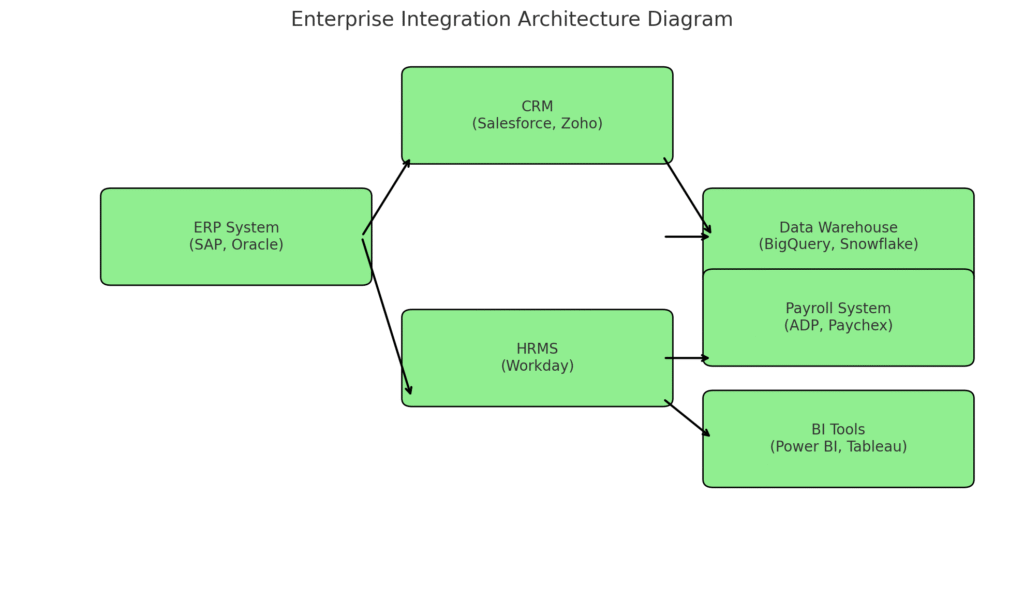
Here is Enterprise Integration Architecture Diagram—now including key systems like:
- ERP (SAP, Oracle)
- CRM (Salesforce, Zoho)
- HRMS (Workday)
- Payroll (ADP, Paychex)
- Data Warehouse (BigQuery, Snowflake)
- BI Tools (Power BI, Tableau)
The arrows represent real-time or batch data flow between systems via APIs, middleware, or event-driven frameworks.
🛠️ Custom Visual: Enterprise Integration Framework
Below is a custom architecture diagram that illustrates a typical enterprise integration structure:
- ERP (SAP/Oracle) integrates with CRM, HRMS, and Data Warehouse.
- Power BI/Tableau connects to the data warehouse for unified reporting.
- Arrows represent real-time or batch-based data flow, managed via APIs or middleware.
🔐 Don’t Forget: Security & Governance
Enterprise systems handle sensitive data. Ensure your integrations include:
- OAuth 2.0 or SAML for secure access
- API rate limiting and logging
- Role-based access control
- Data encryption (in transit and at rest)
Use tools like Kong, WSO2, or Apigee for API security and throttling.
🏁 Final Thoughts
Enterprise integration is essential for digital transformation. It enables real-time operations, eliminates data silos, and supports business intelligence with clean, accessible data.
At Precision Information Technologies, we specialize in:
- Integration architecture planning
- Custom API development
- Middleware configuration
- Real-time & batch data pipelines
Let’s connect your enterprise, one smart integration at a time.
➡️ Ready to modernize your stack? Contact US for a free enterprise integration assessment.