
In 2025, Artificial Intelligence (AI) is not just an assistant in hospitals—it’s a frontline tool for early diagnosis, personalized treatment, and improved patient outcomes. Among all its applications, one of the most transformative trends is AI-powered precision diagnostics.
From oncology and radiology to cardiology and rare diseases, AI is enabling doctors to detect and diagnose medical conditions faster, more accurately, and earlier than ever before.
🔍 What is AI-Powered Precision Diagnostics?
Precision diagnostics with AI refers to the use of machine learning algorithms, computer vision, and neural networks to analyze vast medical datasets—like scans, genomic profiles, EHRs, and blood work—to identify subtle patterns and disease markers that are often missed by the human eye.
📈 Market Growth & Adoption
The global market for AI in healthcare has seen explosive growth over the past five years.
📊 Graph: AI in Healthcare Market Growth (2020–2025)
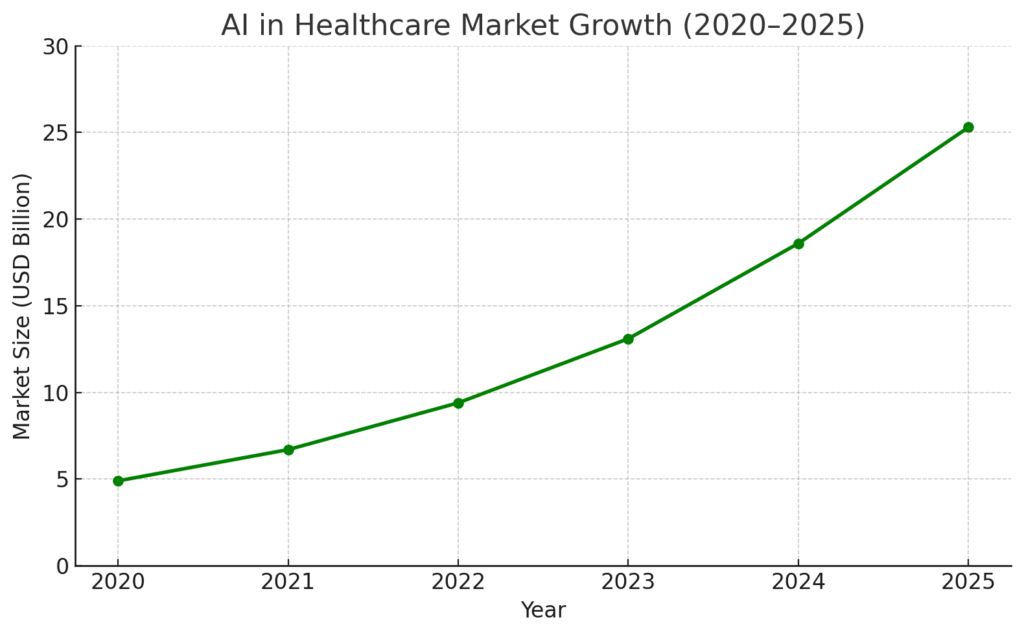
“The market for AI in healthcare is projected to hit $25.3 billion in 2025.”
🏥 Real-World Applications of AI in Medical Diagnostics
1. 🩺 Radiology & Medical Imaging
AI is used to detect abnormalities in X-rays, MRIs, and CT scans with near-human accuracy.
Example:
Google Health’s AI model can detect breast cancer with fewer false positives and negatives than radiologists, as published in Nature.
2. 🧬 Genomics & Rare Disease Detection
AI helps analyze genetic mutations to identify rare diseases and tailor treatment.
Example:
Deep Genomics uses AI to find genetic disorders and propose RNA-based treatments faster than traditional methods.

3. ❤️ Cardiology
AI models assess EKGs and echocardiograms to predict heart disease before symptoms appear.
Example:
The Mayo Clinic developed an AI tool that identifies asymptomatic left ventricular dysfunction from routine EKGs.
4. 🧠 Neurology
AI is being trained to identify early signs of Alzheimer’s, Parkinson’s, and epilepsy from speech patterns, scans, and biomarkers.
Example:
IBM Watson collaborated with researchers to detect Alzheimer’s with 95% accuracy from language usage patterns.
🧠 Benefits of AI-Powered Diagnostics
- ✅ Early detection of life-threatening diseases
- ⏱️ Faster diagnosis and treatment cycles
- 🧪 Higher accuracy with less human error
- 💰 Reduced healthcare costs due to fewer unnecessary tests
- 🌎 Improved access in under-resourced regions via tele-diagnostics
⚠️ Ethical & Regulatory Challenges
Despite its benefits, AI diagnostics come with challenges:
- Data privacy and HIPAA compliance
- Algorithmic bias from non-diverse training data
- Need for explainable AI to gain clinical trust
- Regulatory hurdles from FDA and EMA for AI approval
💡 In 2025, over 500 AI-based medical tools are in the FDA pipeline, reflecting rapid innovation—and the regulatory race to keep up.
🔮 Future Outlook
The next wave of innovation includes:
- AI + Wearables: Predicting health events via continuous monitoring
- Federated Learning: Training AI across hospitals without sharing sensitive data
- Multi-modal AI: Combining imaging, genomics, and patient history for a unified diagnosis
- Digital Biomarkers: Voice, typing, or facial expression analysis to diagnose neurological issues
📚 Final Thoughts
AI in precision diagnostics is no longer experimental—it’s already saving lives. In a world where early detection is the difference between life and death, AI isn’t replacing doctors. It’s making them superhuman.
As we move into an era of predictive, personalized, and preventative care, AI will remain at the core of the modern medical revolution.